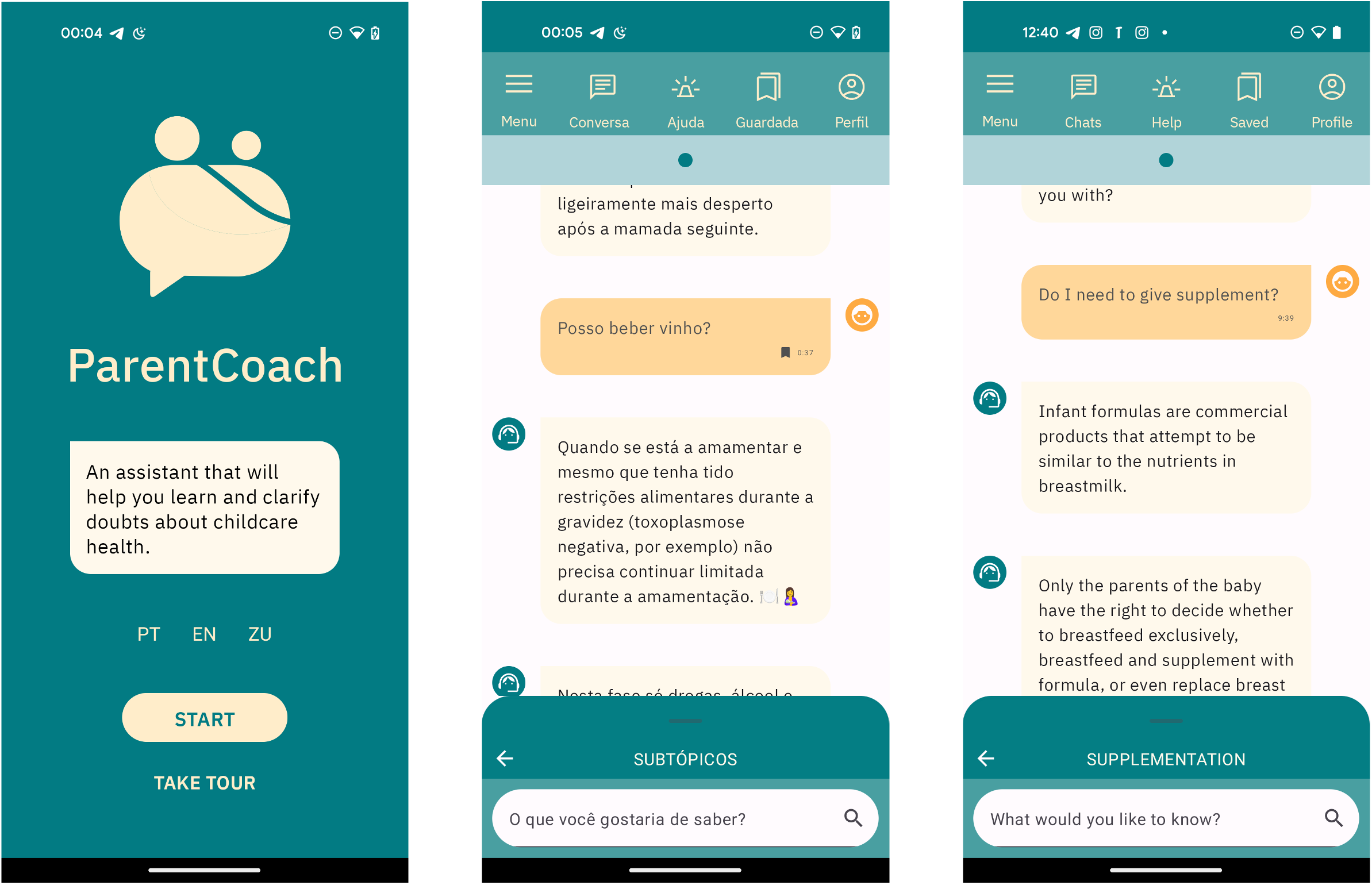
ParentCoach was a research project that focused on creating a chatbot to support first-time parents in caring for the health and wellbeing of their children. We explored the challenges, information needs, and health literacy of parents in Portugal and South Africa, drawing on ethnographic and participatory research with parents, family members, educators, and clinicians. Following insights from the fieldwork, we created a conversation-based app, which was tested in two field trials with first-time parents in Portugal and South Africa. Moreover, ParentCoach fostered sharing and dissemination of knowledge regarding user research, participatory design, and Human-Computer Interaction as a whole between the Portuguese and South African context.
Motivation
Raising a newborn can be a challenging, stressful experience. First-time parents need to learn how to care, nurture, and support their child, but often lack the appropriate learning resources. Moreover, parents in African countries are at higher risk of losing their children to ill health due to inadequate medical care. And while there is a body of scientific literature on neonatal care, access to this information may be restricted and/or is written in an inaccessible manner for parents who are not proficient in scientific or technical literature. Lay articles are widely available, but it is challenging for parents to know whether the information is accurate or appropriate to their context.
ParentCoach started addressing the knowledge gap of parents and families, by democratizing neonatal care knowledge using a chatbot in South Africa and Portugal. Approaching the parents directly with a chatbot has the potential to support learning at scale, without significant costs, enabling also to reach parents that are further away from care professionals.
Approach
ParentCoach built on Aurora, a Facebook Messenger chatbot launched in 2018 and designed to support new parents from pregnancy to the child’s 6th birthday. Aurora was launched in Portugal and served more than 8000 users at its peak. The content of the chatbot was based on evidence-based literature and, through clear and accessible language, aimed to support all issues that were common in early phases of infant care, minimizing exposure and escalation of symptoms, and providing evidence-based solutions to typical symptoms. The accessible language, conversational interaction, and relevant content presented at the right time in Aurora, would help ensure the understanding of public health and practical information for dealing with everyday parenting issues.
We conducted user research and participatory design in Portugal and South Africa, using the interaction with parents, families, and clinicians to create an appropriate chatbot, develop more features, and adapt it to the South African context. We used field trials in both sites, and used these insights to learn about the differences and similarities between the different contexts, and how these impact research results.
Project Goals
With ParentCoach we addressed the knowledge gap of parents and families, by democratizing neonatal care knowledge in Portugal and South Africa. In more depth, our goals were as follows:
- Investigate past experiences and learning practices of parents using the Aurora chatbot;
- Understand health literacy of parents, uncover information needs and experience, and select relevant content to include in the improved Aurora chatbot (Aurora2);
- Engage in participatory design to create content for the Aurora2 chatbot;
- Evaluate the improved Aurora2 chatbot with first-time parents.
Funding
ParentCoach was funded by Fundação para a Ciência e Tecnologia and Aga Khan Development Network (FCT AGA-KHAN / 541742216 / 2019).